
Reportable diseases are diseases that must be brought to the attention of ISGHB immediately, as soon as identified in sheep or goats.
Notifiable diseases are diseases that must be brought to the attention of ISGHB within 48 hours of discovery in sheep or goats.
Learn more about these diseases and how to report the discovery of a case here.
Find state and national disease information and updates here.
Learn more about common sheep and goat diseases here.
Scrapie - Frequently Asked Questions
On July 31, 2026 the USDA confirmed a case of classical scrapie in a sheep slaughtered at an Oregon facility. In light of this case and its proximity to Idaho, the Idaho Sheep and Goat Health Board would like to provide some updated information regarding scrapie surveillance, and the federal programs in place to help sheep and goat producers continue striving for the goal of achieving scrapie-free status as a country.
Scrapie is a fatal, degenerative prion disease of sheep and goats that causes damage to the central nervous system. Susceptible sheep and goats are typically infected when young through contact or ingesting placenta or birth fluids from infected mothers or from ingesting colostrum and milk from infected ewes.
Scrapie has a long incubation period and is difficult to detect as it can take 2–5 years for an animal to show signs of the disease. Current diagnostic testing is limited to using brain or lymphoid tissue.
What is the National Scrapie Eradication Program (NSEP)?
The National Scrapie Eradication Program (NSEP) is a federal program coordinated by the U.S. Department of Agriculture’s Animal and Plant Health Inspection Service (APHIS). The goal of the NSEP is to achieve classical scrapie freedom by identifying and cleaning up the remaining scrapie-infected and source flocks in the United States. The NSEP aims to improve the overall health of the national sheep flock and goat herd, relieve sheep ad goat producers of scrapie-associated economic losses, and increase international marketing opportunities.
The NSEP surveys for scrapie in the United States via the Scrapie Free Flock Certification Program, completing active slaughter surveillance testing of sheep and goats going through processing facilities, collecting reports on suspected animals from producers and veterinarians and conducting live testing of high-risk animals. The program conducts trace investigations, tests exposed animals, and provides effective cleanup strategies to help producers stay in business and preserve breeding stock.
What breeds of sheep and goats get scrapie?
All breeds of sheep and goats are susceptible to scrapie. Susceptibility depends primarily on genetics rather than breed. Approximately 30% of U.S. sheep are genetically susceptible to scrapie. Some animals have been bred to be genetically resistant to scrapie. As scrapie persists in the environment for years, owners of previously infected flocks should restock with rams that are resistant and ewes of resistant or less susceptible genotypes.
How can I prevent the spread of scrapie?
- Ensure that sheep purchased outside of slaughter channels have flock of origin scrapie tags. This includes breeding ewes, rams, and other life stages for grazing.
- Practice strict compliance with ear tagging and traceability requirements to ensure exposed animals can be tracked quickly and accurately.
- Participate in surveillance efforts. Submit clinical suspects to the USDA for testing and implement routine monitoring and testing within your flock or herd.
The SFCP contributes to scrapie surveillance by testing sheep and goats from flocks or herds that may otherwise not be sampled through traditional slaughter surveillance.
The USDA will provide shipping boxes and pre-printed postage-paid labels at no cost to producers and accredited veterinarians for the testing of up to 30 animals per flock per year. Producers and may remove and submit whole head samples through this program, or report deceased sheep or goats and ask for help from their veterinarians with submitting samples.
If you would like to learn more about this program or receive materials for testing call the USDA Veterinary Services office of Idaho at (208) 373-1620.
- Ensure you are building a genetically resistant flock by getting rams and breeding ewes genetically tested for scrapie resistance, which will allow the passing on of resistance to offspring
What is a flock identification number (FIN) and why do I need it?
How can I get scrapie tags?
A flock identification tag or scrapie tag is a federally required identification device approved by APHIS under the National Scrapie Eradication Program (NSEP) that bears an official identification number for individual animals. All official ear tags manufactured must bear an official ear tag U.S. shield imprint and usually included an alphanumeric flock identification number followed by a unique individual animal identification number.
A flock ID/FIN is assigned to a group of sheep or goats managed as a unit on one or more premises under the same ownership. FIN pertains to a group of animals, wherever they move, not a location. One FIN may be related to more than one premise.
Flock ID is vital for tracking diseases, tracing animals during interstate movement, ensuring biosecurity, managing and tracking animal performance, maintaining breeding records, and compliance with federal and state regulation.
Idaho sheep or goat producers who are first time participants in the sheep and goat identification program can get up to 100 Shearwell brand plastic flock ID tags free-of-charge by calling the USDA Veterinary Services office in Boise, Idaho office at 208-373-1620 (option #2). Producers will need to purchase the compatible applicator from the tag manufacturer as it is not included with the free tags.
Visit the USDA’s Sheep and Goat Identification page to learn more and to find USDA approved companies to purchase tags from.
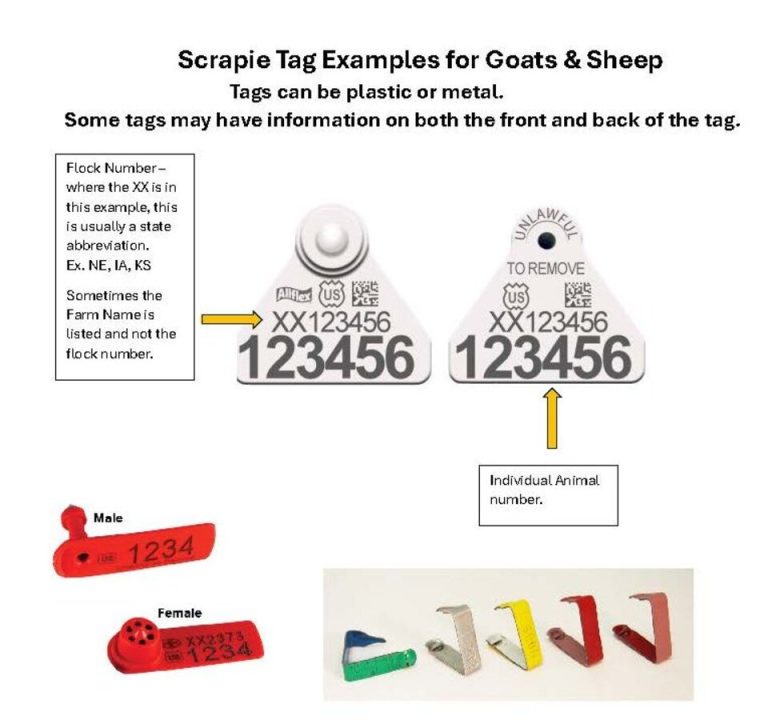
What animals require a scrapie/flock ID tag and which animals are exempt?
Scrapie tags are mandatory for most sheep and goats changing ownership, moving across state lines, or entering public markets or exhibitions. Any breeding sheep and goat must have a scrapie tag before transfer of ownership or possession, show, sale, or other movement unless the animals are under eighteen (18) months of age or in slaughter channels. Any breeding sheep and goats imported into the state of Idaho must be identified with a premises/flock identification number before entry into the state.
Animals exempt from the requirement of identification including a premises/flock identification number include:
- Neutered animals (wether lambs and goats) under eighteen (18) months of age
- Sexually intact market lambs under eighteen (18) months of age shipped directly to an approved slaughter establishment or shipped directly to a feedlot for finish feeding for slaughter only (must be accompanied by an owner/hauler statement that includes info needed to trace the animal’s origin and a certificate of veterinary inspection)
- Animals which have not been removed from their premises of origin and/or transferred ownership except for white-face low-risk range sheep which are moved for grazing or other management purposes that do no change ownership
- Castrated or low-risk commercial goats
- Registered sheep and goats accompanied by registration papers or a certificate of veterinary inspection with legible unique registration tattoos
- Goats registered with a National Goat Registry that allows for electronic implant identification, as recorded on a registration certificate, may be identified with an electronic implant
Please see IDAPA 02.08.01 – Sheep and goat rules of the Idaho Sheep and Goat Health Board for more information regarding Idaho import and export identification requirements.
What is the Scrapie Free Flock Certification Program (SFCP)?
The SFCP began in 1992 as a partnership between APHIS, sheep and goat producers and allied industry. This is a voluntary program that monitors participating flocks for evidence of scrapie. Participation in the SFCP can provide the opportunity to increase marketability and demonstrate scrapie freedom in your flock or herd. There are two categories in the SFC Program:
Export Category – Partnership with the USDA to monitor and sample participating flocks. If conditions are met it can lead to Export Certified status and recognition of negligible scrapie risk.
Select Category – Test samples from mature sheep and goats to identify and remove infected flocks.
In order to achieve either level of certification in the SFCP you must meet criteria outlined in the Scrapie Free Flock Certification Program (SFCP) Standards. Learn more about the SFCP and how to apply by contacting scrapie@usda.gov.